Curriculum
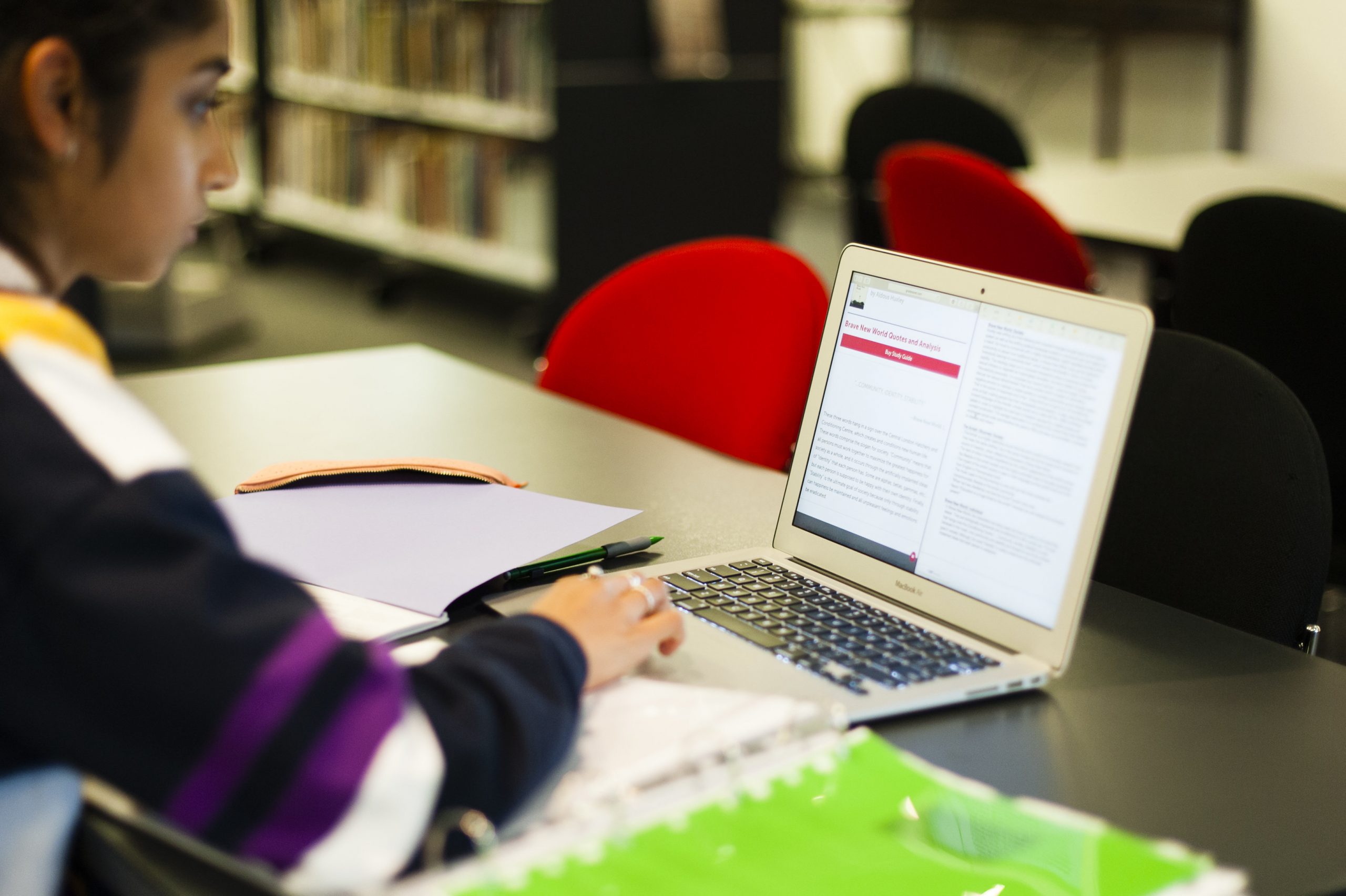
St Leo’s Catholic College offers a comprehensive and balanced curriculum for all year groups that nurtures each student’s academic, personal and spiritual development. Students build strong foundations in core subjects while progressively exploring a wide range of elective areas that reflect their interests and strengths, fostering independence, confidence and a love of learning.
As they move into the senior years, a diverse selection of academic and vocational courses enables students to tailor their studies towards university, TAFE, apprenticeships or employment pathways. Supported by a dedicated careers program and a strong focus on wellbeing and faith formation, students at St Leo’s are guided to make informed choices and are well prepared to step confidently into their future.
Religion
We are a community framed by our Catholic faith, where all are welcome and encouraged to explore the traditions of our Church and the foundations of our faith in Jesus Christ.
Religious education classes are compulsory across Year 7 to Year 12. Throughout stages 4 and 5, each year group will follow a Diocesan based curriculum that guides our study through the themes of Scripture and Jesus; Church and Community; God, Religion and Life; Prayer, Liturgy and Sacraments; and Morality and Justice. For Stage 6, students are able to choose to study the NESA course Studies of Religion or a Diocesan course Studies in Catholic Thought.
| Years 7 and 8 | Years 9 and 10 | Years 11 and 12 |
|---|---|---|
| Stage 4 | Stage 5 | Stage 6 |
| Religious Education (compulsory) | Religious Education (compulsory) | Studies of Religion 1 and 2 unit courses |
| Studies in Catholic Thought 1 and 2 unit courses |
Course Highlights
Our Religious Education courses invite students to actively explore the richness of the Catholic faith in an open and engaging environment. Students are encouraged to ask questions and develop a deeper understanding of the Church through the study of its symbols, sacred spaces, and rituals. Throughout the course, they encounter a variety of faith practices including prayer, Scripture reading, Mass, and liturgy. Opportunities are also provided for reflection through meditation, artwork, and other creative expressions. By engaging with both traditional and creative forms of learning, students are supported in exploring Catholic beliefs and traditions in ways that are meaningful, reflective, and personally enriching.
Extension/other opportunities
Youth Ministry@St Leos!
Our youth ministry program provides opportunities for students from Years 7 to 12 to explore their faith in a personal, authentic and practical way. (See additional information regarding Youth Ministry in the extra-curricular section).
Everyone is welcome. It is not necessary to be Catholic to explore our Church and our CommunityWe look to the Church and our Scriptures as the foundation of a lived expression of faith. Study is brought to contemporary life to explore how faith can be an integral part of this life.
We explore all of the major world religions in Year 11 and undertake depth studies in Year 12 across 2–3 of the religious traditions, focusing on specific aspects of each of these traditions.
English
At its core, the NSW English Curriculum aims to develop students who are:
- Confident communicators
- Critical and creative thinkers
- Empathetic and informed citizens
- Skilled interpreters and composers of texts.
In a world saturated with information, students must do more than read and write – they must analyse, question, interpret and respond. In English, at St Leo’s we explicitly teach our students how language works, how meaning is shaped, and how texts influence audiences. These skills empower young people to navigate media, evaluate perspectives and engage thoughtfully with diverse viewpoints.
| Years 7 and 8 | Years 9 and 10 | Years 11 and 12 |
|---|---|---|
| Stage 4 | Stage 5 | Stage 6 |
| English (compulsory) | English (compulsory) | English Advanced |
| English Standard | ||
| English Studies | ||
| English Extension 1 | ||
| English Extension 2 |
Course Highlights
- Writer’s Festival Excursion
- Bell Shakespeare productions
- Public Speaking
- The Premier’s Reading Challenge.
Clubs and Competitions
- The Writers’ Collective
- Debating
- Tempest/Hagseed Symposium
- Poetry in Action.
Mathematics
Mathematics at St Leo’s is compulsory from Years 7 to Year 10 and continues into a range of Stage 6 courses. We recognise that students enter our classrooms with varying prior knowledge, confidence levels and interest in the subject. In response to the NESA curriculum reform, our teaching emphasises explicit instruction, deep conceptual understanding, and structured opportunities for reasoning and problem solving. We are committed to maximising every student’s potential through high expectations, embedded scaffolds, and extension opportunities.
Across all year levels, students experience consistent routines, clear learning intentions, and feedback that helps them understand where they are, what their next achievable goal is, and how to improve. Our approach prioritises growth, independence and mathematical thinking so that every student can progress with clarity and confidence.
| Years 7 and 8 | Years 9 and 10 | Years 11 and 12 |
|---|---|---|
| Stage 4 | Stage 5 | Stage 6 |
| Mathematics (compulsory) | Mathematics (compulsory) | Mathematics Extension 1 |
| Mathematics Elective (Years 9 and Year 10) | Mathematics Extension 2 | |
| Maths Ignite (cross-campus opportunity | Mathematics Advanced | |
| Mathematics Standard 1 | ||
| Mathematics Standard 2 | ||
| Numeracy (non-ATAR) |
Course Highlights
Explicit teaching that balances procedural fluency with reasoning and problem solving
A structured and supportive assessment design that builds confidence while extending higher-order thinking
Clear language of achievement that helps students understand their progress and identify meaningful next steps
Feedback processes that prioritise growth, reflection and improvement
Real-world applications of mathematics through investigative tasks and financial literacy experiences
Extension/other opportunities:
At St Leo’s, we recognise that students grow in mathematics at different rates and with different levels of confidence and enthusiasm. We provide structured support and enrichment so that every learner can progress with clarity and challenge.
For students who would benefit from additional support:
- Maths Support Club is open to all students and offers small group and one-to-one support to consolidate understanding and build confidence.
- Years 7–9 Maths Supplementary Program leverages learning technology and guided support to strengthen foundational skills and promote independent revision habits.
- Year 10 grouped learning structures allow students to learn at a pace and depth that best supports their readiness for senior mathematics.
- Years 11–12 course structures provide opportunities within each course for students to work at an appropriate level of rigour while being supported towards their personal goals.
For students seeking enrichment and challenge:
- Maths Enrichment Club is open to all students who enjoy mathematical challenge and problem solving through various competitions and activities.
- Years 9 and 10 Mathematics Elective school-based course and Maths Ignite cross-campus course offer opportunities to explore mathematics beyond the core curriculum.
- Years 11–12 courses provide extension opportunities within and across subjects for students who wish to pursue mathematics at a higher level.
Science
Science is a compulsory subject for all students in Years 7–10, studied for approximately 6 hours per fortnight. The NSW Science 7–10 syllabus is designed to develop students’ understanding of the natural and physical world, while building strong skills in scientific inquiry, critical thinking, and evidence-based reasoning.
The course integrates the study of Living, Physical, Chemical and Earth & Space sciences, with a strong emphasis on hands-on practical work, collaborative investigations, and real-world applications. Students learn not only scientific knowledge, but how science works. How to ask questions, design investigations, analyse data, and communicate findings. At Open Days, families often ask about practical work, pathways into senior science, and relevance beyond school. Science at our school provides a strong foundation for Stage 6 science subjects, STEM careers, and scientific literacy for everyday life.
| Years 7 and 8 | Years 9 and 10 | Years 11 and 12 |
|---|---|---|
| Stage 4 | Stage 5 | Stage 6 |
| Science (compulsory) | Science (compulsory) | Biology |
| Chemistry | ||
| Physics | ||
| Investigating Science |
Course Highlights
Stages 4 and 5: Students study a balanced program drawn from the four strands of the NSW syllabus: Living World, Physical World, Chemical World, Earth & Space.
Key features across Years 7–10 include:
- Regular practical investigations and laboratory work
- Explicit teaching of Working Scientifically skills
- A mandatory Student Research Project in each year of Stage 4 and Stage 5
- Integration of digital technologies, data collection tools, and scientific modelling.
Biology suits students interested in health, medicine, environmental science, psychology, veterinary science and life sciences.
Chemistry is essential for pathways into medicine, pharmacy, engineering, forensic science, and many STEM degrees.
Physics develops strong problem-solving and mathematical skills, supporting careers in engineering, aviation, computing, and physical sciences.
Investigating Science is ideal for students who enjoy applied science, research, and interdisciplinary problem-solving, and complements other Stage 6 science subjects.
Excursions
- Year 7 Taronga Zoo (Classification and adaptations)
- Year 8 Fagan Park (Ecology)
- Year 9 Forensic Incursion
- Year 11 Biology (Ecosystem)
- Year 12 Investigating Science and Biology: Museum of Disease
- Year 12 Chemistry: Orica Chemistry Plant
Extension/other opportunities
Science Club – This club gives students the chance to explore curiosity beyond the classroom, building creativity, problem‑solving and teamwork through hands‑on, student‑driven activities. It supports diverse pathways, and helps students see science as engaging, relevant and fun.
HSIE (Human Society and Its Environment
In Years 7–10, HSIE (Human Society and Its Environment) in the NSW curriculum is made up of both mandatory and elective subjects that develop students’ understanding of society, history, geography and citizenship. History and geography are mandatory subjects, building students’ knowledge of past societies, historical skills, places, environments and global interconnections. Schools may also offer elective HSIE subjects such as commerce, which develops financial literacy and consumer skills, and Aboriginal Studies, which deepens understanding of Aboriginal histories, cultures and contemporary issues. Together, Years 7–10 HSIE subjects aim to create informed, active and responsible citizens who can think critically about the world around them.
In Stage 6 (Years 11–12), HSIE subjects in the NSW curriculum allow students to specialise in understanding societies, cultures, economies and the past in greater depth. Courses include ancient history, modern history and history extension, which develop advanced historical analysis and research skills, as well as geography, focusing on global challenges and spatial thinking. Social science subjects such as economics, business studies, legal studies, and society and culture examine how societies and systems operate and change, while Aboriginal Studies deepens understanding of identity, belief and cultural perspectives. Together, Stage 6 HSIE subjects prepare students for active citizenship, further study and a wide range of career pathways.
| Years 7 and 8 | Years 9 and 10 | Years 11 and 12 |
|---|---|---|
| Stage 4 | Stage 5 | Stage 6 |
| Science (compulsory) | Science (compulsory) | Biology |
| Chemistry | ||
| Physics | ||
| Investigating Science |
Course Highlights
Students explore a variety of topics in History ranging from Ancient Egypt to the creation of the United Nations and Human Rights.
Students explore a variety of topics in geography ranging from physical geography in units such as Landscapes and Landforms and Environmental Change and Management to Human Geography in units such as Place and Liveability and Human Wellbeing
Extension/other opportunities
The Society and Culture Personal Interest Project (PIP) and the History Extension Historical Investigation provides students with the opportunity to showcase their independence, intellectual curiosity and advanced research skills. In both projects, students select a topic or question of personal interest and engage in sustained, self‑directed research. The PIP allows students to apply social research methods to contemporary social and cultural issues, while the Historical Investigation challenges students to evaluate historiography and construct a sophisticated, evidence‑based historical argument. Together, these projects enable students to demonstrate critical thinking, analytical writing and academic research skills valued by universities and future pathways.
Languages
Learning a second language strengthens cognitive load, fosters inclusivity and builds commitment and resilience within learners. At St Leo’s, we capitalise on those opportunities through the teaching of the Japanese language. Students learn how to interact, create and understand texts in Japanese as well as how to read and write the three Japanese scripts of Hiragana, Katakana and Kanji. Students also engage with various Japanese cultural aspects to create and deepen their intercultural knowledge and understanding. This opens a line of enquiry about where and how others live, fostering communication skills and future professional prospects.
Course Highlights
The Modern Languages syllabus in Stage 4 (Year 8) explores the foundations of both learning a second language and the Japanese language. The focus of their introductory year to Japanese is on the Personal World. Students are taught the foundations of the Hiragana writing script along with basic Kanji characters. They engage with vocabulary and grammatical structures that teach them to communicate personal information (name, age, birthday, family), along with foods and likes and dislikes. Throughout the course, students also engage in cultural lessons where they deepen their cultural, social and historical knowledge about Japan.
Students can also choose to study a language not offered at the College, through NSW School of Languages. Additional subjects may also be available online or through distance education.
| Years 7 and 8 | Years 8 and 9 | Years 11 and 12 |
|---|---|---|
| Stage 4 | Stage 5 | Stage 6 |
| Modern Languages - Japanese (compulsory) | Modern Languages - Japanese (200 hour elective course) | Japanese Beginners (cross-campus course) |
| Japanese Continuers | ||
| NSW School of Languages Language courses (distance education) |
Extension/Other Opportunities
St Leo’s offers a Japan Club once a week during lunch. Japan Club aims to further delve into Japanese culture and history, exploring more in-depth aspects of both.
There is also the possibility of participating in an overseas trip to Japan. This trip occurs once every two years and is only offered to Elective Japanese students. It provides an incredibly opportunity for students to practice what they have learnt in a real-world context.
PDHPE (Personal Development, Health and Physical Education
PDHPE is a compulsory subject that supports students’ physical, social and emotional development through both practical and theory lessons each week. The course develops movement skills, game understanding and health knowledge, while promoting teamwork, resilience and respectful relationships. Our approach encourages active participation and builds the confidence and skills needed for lifelong health and physical activity.
| Years 7 and 8 | Years 9 and 10 | Years 11 and 12 |
|---|---|---|
| Stage 4 | Stage 5 | Stage 6 |
| PDHPE (compulsory) | PDHPE (compulsory) | Health and Movement Science (HMS) |
| PASS (elective) | Community and Family Studies (CAFS) | |
| Child Studies (elective) | Exploring Early Childhood (EEC) | |
| Sports, Lifestyle and Recreation (SLR) |
Course Highlights
Practical opportunities to develop a range of skills in real world environments, including swim school, surf education and RealCare babies. The new HMS course allows students to dive deeper into content of interest through depth studies and collaborative investigations. Recent depth studies include investigating the health knowledge of young people, the energy systems needed for a variety of sports, and the local community programs targeting the improvement of health for different populations.
Extension/Other Opportunities
- CSBB sporting events and gala days
- Interschool competitions
- Sports Aerobics
- Football Academy.
TAS (Technological and Applied Studies)
The Technology and Applied Studies (TAS) faculty at St Leo’s Catholic College provides students with opportunities to design, create and innovate using a wide range of technologies, materials and processes. Through hands-on learning experiences, students develop practical skills, creative thinking and problem-solving abilities while exploring how technologies shape the world around them.
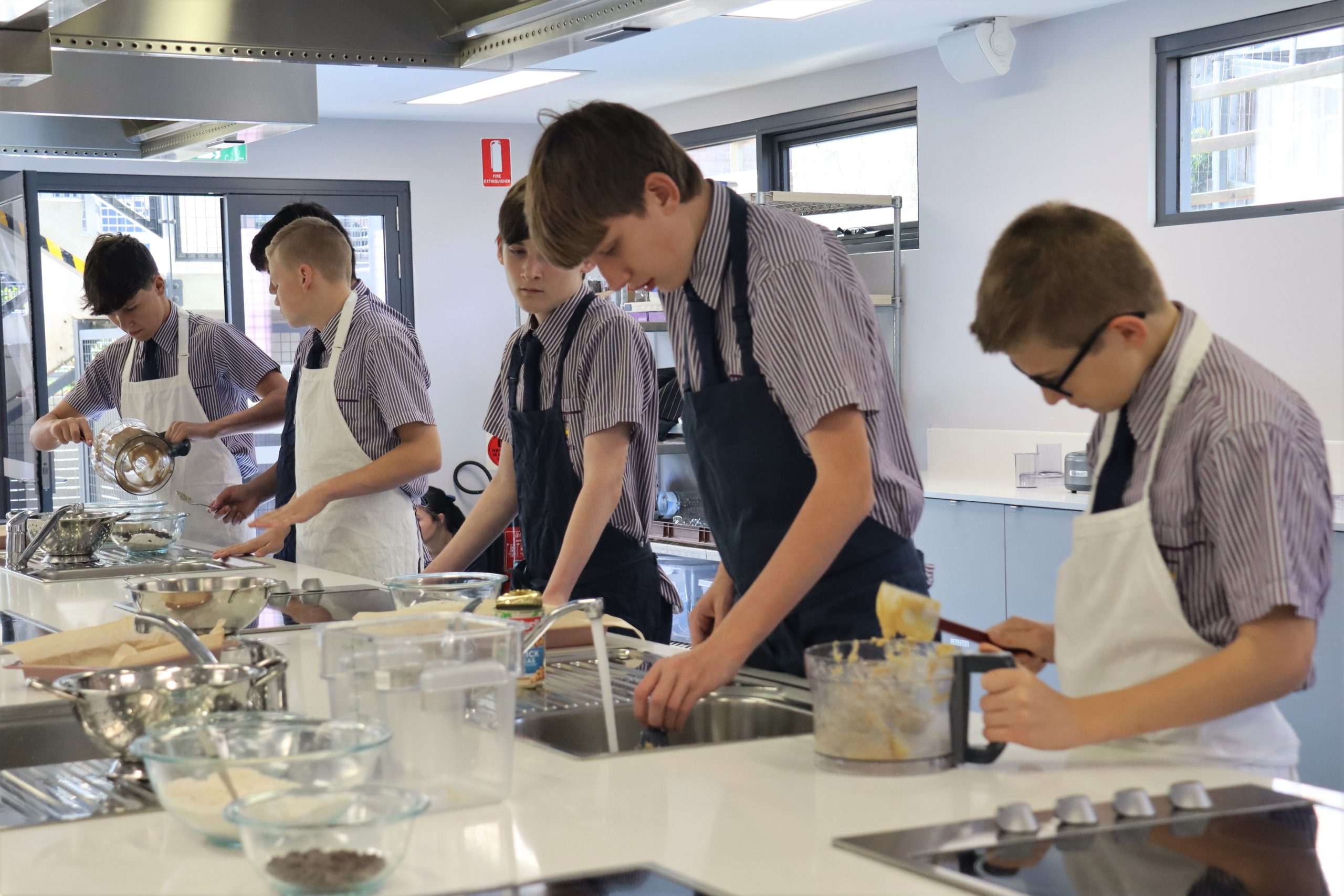
Across Years 7–12, students engage in areas such as engineering, digital technologies, food, agriculture, timber, design and emerging technologies. Our programs combine traditional workshop skills with modern digital fabrication, including CAD design, 3D printing and laser cutting, preparing students with the skills, creativity and confidence needed for future study, careers and everyday life.
| Years 7 and 8 | Years 9 and 10 | Years 11 and 12 |
|---|---|---|
| Stage 4 | Stage 5 | Stage 6 |
| Technology (Timber, Design, Multimedia, Engineering, Food and Agriculture) | Food Technology | Food Technology |
| Industrial Technology Timber | Industrial Technology Timber | |
| Design and Technology | Design and Technology | |
| Engineering Studies | Engineering Studies | |
| Textiles and Design |
Course Highlights
Students engage in practical, hands-on learning through a variety of design and production projects including timber products, engineering challenges, digital media, textile design and food creation. In Stage 6, students complete substantial HSC Major Design Projects, where they investigate a real-world need, develop and test ideas, and produce a final solution using professional tools and processes. These experiences help students build creativity, problem-solving and technical skills while exploring pathways into future careers and professions such as engineering, architecture, industrial design, digital media, hospitality, fashion and skilled trades.
Extension/Other Opportunities
Students have opportunities to extend their learning through design challenges, project showcases and participation in competitions that celebrate creativity, innovation and problem solving. Senior students also present their HSC Major Design Projects, with outstanding works potentially nominated for external exhibitions such as the SHAPE Exhibition, where exemplary student projects from across NSW are displayed. These opportunities allow students to share their work with the wider school community and recognise high levels of achievement in TAS subjects.
CAPA (Creative and Performing Arts)
CAPA at St Leo’s consists of Music, Dance, Drama and Visual Arts. Within these core subjects, students experience and develop the complex skills required to create and test ideas, generate creative works with confidence, shape inquiry and critically evaluate and reflect on what they do. It is essential for personal, social, and cultural development, preparing students to become meaningful contributors to society and informed consumers of culture.
| Years 7 and 8 | Years 9 and 10 | Years 11 and 12 |
|---|---|---|
| Stage 4 | Stage 5 | Stage 6 |
| Visual Arts (compulsory, semesterised) | Visual Arts | Visual Arts |
| Music (compulsory, semesterised) | Music | Music |
| Dance | Dance | |
| Drama | Drama | |
| Photography and Digital Media | Photography | |
| Video | ||
| Digital Imaging |
Course Highlights
- Excursions
- Showcases
- CAPA Camp
- Musical and Drama Productions
- Numerous extra-curricular opportunities (see extra-curricular).
Extension/Other Opportunities
The CAPA Cubs program is a great foundation for your child to experience the world of Creative and Performing Arts. As part of their curriculum, Year 7 attend classes in both music and visual arts. Our CAPA Cubs program enables students to experience all Creative and Performing Arts subjects without having to wait until selecting their electives in Year 9. The CAPA Cubs program offers the fundamentals found in each of our CAPA (dance, music, art, drama) subjects and provides the opportunity for your child to explore their skills and interests leading up to their Stage 5 education.
VET (Vocational and Educational Training)
Vocational Education and Training (VET) courses give students the opportunity to develop practical, industry-relevant skills while completing their senior studies. VET is competency-based and aligned to national training packages, allowing students to work towards a nationally recognised qualification and gain experience that supports further training, apprenticeships, traineeships, or employment after school.
| Years 9 and 10 | Years 11 and 12 |
|---|---|
| Stage 5 | Stage 6 |
| Activate | Hospitality Cookery |
| Construction Pathways | |
| Furniture Making Pathways | |
| Business Services |
Course Highlights
- Students have the ability to gain a nationally recognised qualification.
- Externally run courses through TAFE and other Registered Training Organisations: TAFE, University New England, Taronga Zoo,
- Student Based Apprenticeships – students start apprenticeship or traineeship whilst still at school.
Extension/Other Opportunities
- Additional qualifications on offer: First Aid, Coffee School, White Card, RSA and RCG
- Regional and National Competitions – World Skills VETiS, Battle of the Chef’s, Battle of the Business Assistants, Battle of the Builders.